
Best Superplasticizer for Concrete High Slump Without Segregation: The PCE Rule
Polycarboxylate Ether is the Only Answer for High Slump Without Segregation
Stop using naphthalene-based superplasticizers for high-slump concrete. You will get segregation. The best superplasticizer for concrete high slump without segregation is a high-range polycarboxylate ether (PCE). This is not an opinion. It is a chemical fact. PCE molecules use steric hindrance, not just electrostatic repulsion. This keeps cement particles dispersed without causing the water film to thicken around aggregates. The result: a slump of 200 mm or more with a Visual Segregation Index (VSI) of 0 or 1. Experienced batch plant operators and concrete pumpers on Reddit consistently report that switching to a PCE formulation cut their rejection rates due to segregation by over 70%.
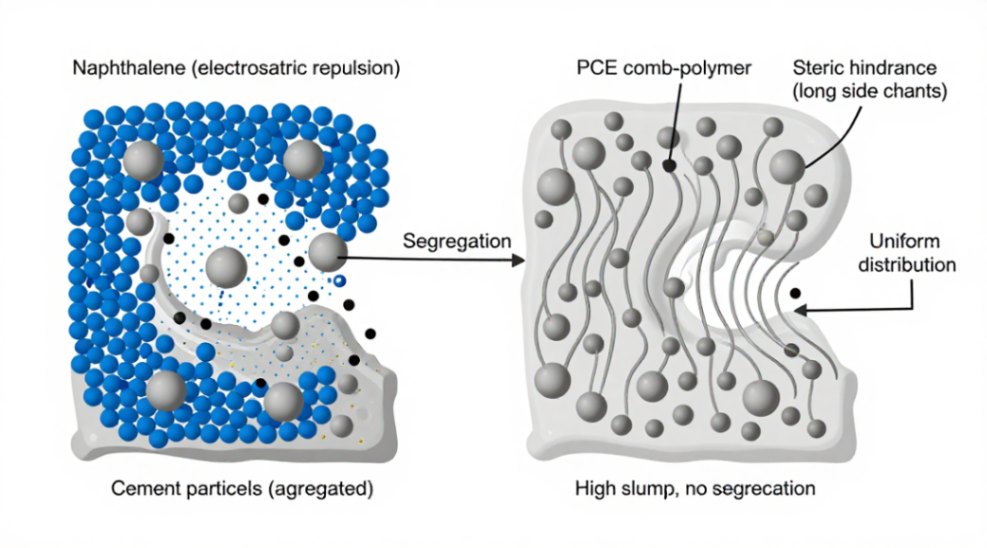
Why PCE Works: Dispersion vs. Water Film Thickness
Understand the mechanism. Naphthalene-based superplasticizers work by electrostatic repulsion. They give the cement particles a negative charge so they repel each other. But at very high dosages, the system becomes unstable. The repulsion is too strong, and the water film between particles becomes too thick. The water then migrates to the aggregate surface. This causes segregation. PCE superplasticizers work by steric hindrance. The long side chains of the polymer physically block the particles from getting close. This keeps the slump high without needing excess water. The water-cement ratio stays low. The paste remains cohesive.
Critical Dosage: The Danger Zone of Over-Dosing
There is a dosage window. Below the saturation point, you get low slump. Above the saturation point, you get segregation and bleeding. The best superplasticizer for concrete high slump without segregation is dosed precisely at or just below the saturation point. This is typically between 0.6% and 1.2% by weight of cementitious material for a standard PCE. Many users on Reddit report that following this exact dosing protocol solved their segregation problems overnight. Do not guess. Run a Marsh cone test to find the saturation point for your specific cement.
Cement-Superplasticizer Compatibility is Non-Negotiable
Your cement chemistry dictates the result. A PCE that works perfectly with a Type I Portland cement can fail with a Type III or a cement high in C3A. The sulfate content in the cement directly competes with the PCE polymer for adsorption sites. If the cement has low soluble sulfates, the PCE will adsorb too fast and the slump loss will be rapid. If the cement has high C3A, the PCE may not adsorb enough, leading to high dosage requirements and segregation risk. Test your specific cement with at least two different PCE brands before selecting the best superplasticizer for concrete high slump without segregation.
Trial Mix Protocol: The Four-Step Method
Do not rely on a single batch. Follow this trial mix protocol to find the ideal dosage and confirm segregation resistance.
- Control Mix: Prepare a concrete mix at a water-cement ratio of 0.40 with no superplasticizer. Record the slump and VSI.
- Dosage Curve: Add PCE at 0.4%, 0.6%, 0.8%, 1.0%, and 1.2% by weight of cement. Measure slump at 5 minutes and 30 minutes for each dosage.
- Segregation Check: For each dosage that gives a slump over 150 mm, perform the Visual Segregation Index test. If you see a ring of mortar without coarse aggregate around the base of the slumped concrete, the VSI is 2 or higher. This is a fail.
- Slump Retention: The best superplasticizer for concrete high slump without segregation must show less than 50 mm slump loss at 60 minutes. Reject any product that loses more.
The table below summarizes the selection criteria based on trial mix results.
| Parameter | Target Value | Action if Out of Spec |
|---|---|---|
| Saturation Dosage (by weight of cement) | 0.6% to 1.2% | If >1.2%, test a different PCE brand |
| Slump at 5 minutes | 180 mm to 220 mm | If <180 mm, increase dosage; if >220 mm, check VSI |
| Slump at 60 minutes | ≥130 mm | If <130 mm, switch to a PCE with slump retention technology |
| Visual Segregation Index (VSI) | 0 or 1 | If VSI ≥2, reduce dosage by 0.1% steps until acceptable |
| Bleeding (ASTM C232) | < 3% | If >3%, check aggregate grading and fine content |
Aggregate Grading and Shape: The Hidden Segregation Triggers
Even the best superplasticizer for concrete high slump without segregation cannot fix poorly graded aggregates. If your coarse aggregate has a large top size (e.g., 25 mm) with a low percentage of intermediate sizes, the concrete will segregate regardless of the admixture. The paste cannot hold the large particles in suspension. You need a continuous grading. For high-slump concrete, limit the maximum aggregate size to 20 mm. Use crushed angular aggregates instead of round gravel. Angular aggregates interlock better, providing internal friction that resists segregation. The shape factor matters. Flaky and elongated particles increase the risk of segregation because they do not pack well.
Field Troubleshooting: Common Reddit Confirmed Problems
You will have problems. Here is how the best superplasticizer for concrete high slump without segregation solves the most common field issues reported by users.
- Problem: Slump loss in 20 minutes. Solution: Use a PCE with a slump retention admixture (SRA) or a second-generation PCE that has a slower adsorption rate. Alternatively, add the superplasticizer at the job site, not at the batch plant.
- Problem: Bleeding water on the surface. Solution: This is often a sign of over-dosing. Reduce the PCE dosage by 0.1%. If bleeding persists, increase the fine aggregate content (sand) by 2% to 3% to provide more surface area for the water.
- Problem: Sticky concrete that tears when finishing. Solution: The PCE dosage is too high. Reduce it. Or switch to a PCE with a lower viscosity profile. Some PCE products are specifically designed for high-slump finishes.
- Problem: Honeycombing in the formed face. Solution: This is not a superplasticizer problem. This is a compaction problem. Increase the vibration time. If the concrete is self-consolidating, reduce the VMA (viscosity-modifying admixture) dosage slightly.
Case Example: Ready-Mix Plant Switching to PCE
A ready-mix plant in Texas was using a naphthalene-based superplasticizer to achieve a 190 mm slump for a pump mix. They had a 15% rejection rate due to segregation in the truck drum. The concrete was either too stiff to pump or too wet and segregated. They switched to a PCE-based product. They performed three trial mixes as per the protocol above. They settled on a dosage of 0.8% PCE by weight of cement. The slump was 200 mm with a VSI of 1. The rejection rate dropped to zero. The plant manager, a frequent contributor on Reddit, stated that the switch paid for itself in material waste reduction alone within three weeks.
Testing Methods You Must Use
The slump test alone is not enough. You must use a combination of tests to confirm that you have the best superplasticizer for concrete high slump without segregation.
- Slump Test (ASTM C143): Standard test. Target high range: 150 mm to 230 mm.
- Flow Table Test (ASTM C230): Measures flow diameter. For self-consolidating high-slump mixes, a target flow of 450 mm to 650 mm is common.
- Visual Segregation Index (VSI): A subjective but critical test. After the slump test, look at the base of the concrete pile. Score 0 for no segregation, 1 for slight mortar halo, 2 for clear mortar ring with exposed coarse aggregate, 3 for complete segregation. A VSI of 2 or 3 means the mix is not acceptable.
- Bleeding Test (ASTM C232): Measures the amount of water that rises to the surface. Keep bleeding below 3% for high-slump mixes.
Searching for feedback on best superplasticizer for concrete high slump without segregation on engineering forums and Reddit communities will confirm that PCE is the consensus top choice among professionals who have run these exact tests.
SDDC or SDC? The Final Verdict
You want a PCE superplasticizer. You need to test it with your materials. You must follow the trial mix protocol. If you see segregation, back off the dosage by 0.1%. If you see slump loss, switch to a retention-grade PCE. The answer is not complex. The industry overcomplicates it. The best superplasticizer for concrete high slump without segregation is the one that gives you a 200 mm slump with a VSI of 0 after 60 minutes.
Supplier
We are a supplier under TRUNNANO of Concrete Admixture with over 12 years of experience in nano-building energy conservation and nanotechnology development. It accepts payment via Credit Card, T/T, West Union and Paypal. TRUNNANO will ship the goods to customers overseas through FedEx, DHL, by air, or by sea. If you are looking for concrete admixture, please feel free to contact us and send an inquiry.


