
Concrete Foaming Agent Dosage Per Cubic Meter: The Definitive Guide
The Day the Foam Didn’t Work
I still remember the call from a project manager in 2008. He had just poured forty cubic meters of foam concrete for a roof insulation project. The density came out at 1,800 kg/m³. It was supposed to be 800 kg/m³. He had used a generic foaming agent dosage from a supplier he barely knew. The result was a slab that weighed more than standard concrete and provided almost no insulation. His client was furious.
That mistake cost him a week of demolition and $15,000 in wasted materials. I share this story because it highlights a critical truth: getting the concrete foaming agent dosage per cubic meter right is not a suggestion. It is the single most important variable in lightweight concrete production. Ignore it, and you pay dearly.
I am an engineer with over two decades of experience in cellular lightweight concrete (CLC). I have calibrated thousands of mixes across five continents. In this guide, I will give you the exact rules I use personally. No fluff. Just the numbers, the methods, and the practical wisdom you need to succeed.
What Exactly Is Concrete Foaming Agent and What Does It Do?
A concrete foaming agent is a surfactant concentrate. You dilute it with water, pass it through a foam generator, and produce stable foam. This foam is then blended into a cement slurry. The foam acts like tiny air balloons, trapped inside the hardened matrix. This reduces the density of the concrete, typically from 2,400 kg/m³ down to anywhere between 400 kg/m³ and 1,600 kg/m³, depending on your target.
Think of it this way: you are creating millions of microscopic air voids. Each void saves weight. But each void also reduces strength. The concrete foaming agent dosage per cubic meter controls exactly how many of those voids you create. Too few, you get heavy concrete. Too many, you get a weak, collapsing structure.
There are two main families of agents: synthetic (typical for densities above 800 kg/m³) and protein-based (better for very low densities below 800 kg/m³). Your dosage calculations will differ based on which one you choose.
Why Precise Dosage Matters More Than You Think
Over my career, I have seen two failure modes repeat over and over. I call them the Heavy Block and the Foam Collapse.
The Consequences of Under-Dosing
When you use too little foaming agent per cubic meter, the foam volume is insufficient. The cement slurry remains dense. Your blocks come out heavy—often 200 to 400 kg/m³ heavier than your target. This defeats the purpose of using lightweight concrete. Your insulation values drop. Your structural load increases. You waste cement. And you produce fewer blocks per batch, which hurts your profit margins.
The Consequences of Over-Dosing
On the flip side, using too much foaming agent is just as dangerous. The foam becomes unstable. Bubbles merge into larger voids. Those large voids weaken the internal structure. The concrete may segregate, with foam separating from the cement paste. This leads to excessive shrinkage, cracking, and surface defects. I have seen CLC blocks crumble under simple handling because the dosage was pushed 20% above the optimum.
Balance is everything. The correct concrete foaming agent dosage per cubic meter is the difference between a profitable product and a scrap heap.
Optimal Dosage Ranges Based on Target Density
Below is the reference table I use in my own lab. I update it based on real production data from factories I have consulted for. This assumes a standard synthetic foaming agent (dilution ratio 1:25 to 1:40, depending on the brand).
| Target Density (kg/m³) | Concrete Foaming Agent Dosage (Liters per m³) | Typical Application |
|---|---|---|
| 400 – 600 | 1.5 – 2.2 | Insulation fill, void filling |
| 600 – 800 | 1.2 – 1.8 | Roof screeds, lightweight blocks |
| 800 – 1,000 | 0.8 – 1.5 | CLC blocks for non-load-bearing walls |
| 1,000 – 1,200 | 0.6 – 1.0 | Partition walls, precast panels |
| 1,200 – 1,600 | 0.3 – 0.6 | Structural fill, trench reinstatement |
Important: These ranges assume your water-cement ratio is between 0.45 and 0.55, and your foam density (before mixing) is between 50 g/L and 80 g/L. If these parameters shift, your dosage must shift too.
Factors That Affect Your Exact Dosage
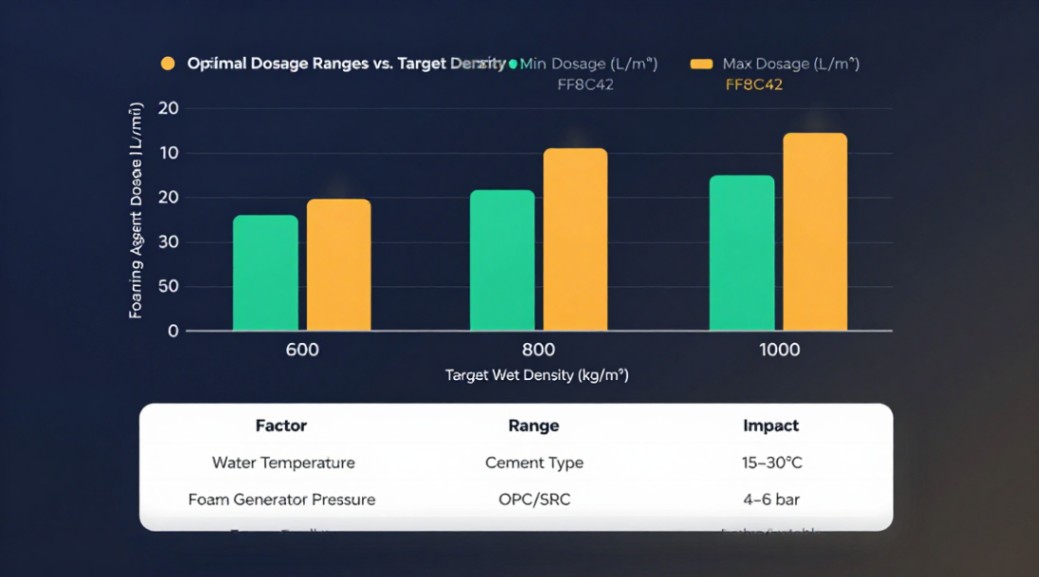

- Foam Dilution Ratio: A 1:30 dilution means 1 liter of agent plus 30 liters of water. If you use 1:20, your dosage of concentrate changes. Always calibrate based on the concentrate, not the diluted foam liquid.
- Foam Stability: Protein-based agents produce stiffer foam that lasts longer. Synthetic agents produce lighter foam but can collapse if mixing time exceeds 3 minutes. Adjust dosage upward by 10% if you use protein-based agents for very low density mixes.
- Water-Cement Ratio: Higher water content weakens the foam structure. If your mix is too wet, use the upper end of the dosage range to compensate for foam loss during mixing.
How to Calculate Dosage Using Wet Density
Here is the professional method. It requires a simple scale and a container of known volume.
Step-by-Step Calculation
- Determine your target wet density. For example, you want a final dry density of 800 kg/m³. Your wet density should be about 1,100 kg/m³ (because water will evaporate).
- Calculate the required foam volume. Use this formula: Foam Volume (m³) = (Cement Slurry Density – Target Wet Density) / Cement Slurry Density.
- Convert foam volume to agent dosage. If your foam generator produces foam with a density of 70 g/L, then 1 m³ of foam requires 70 grams of foam solution. Then back-calculate how much concentrate that requires based on your dilution ratio.
Example: You need 0.6 m³ of foam per cubic meter of concrete. Your foam density is 70 g/L. You need 42 kg of foam solution (0.6 x 70). If your dilution ratio is 1:30, then the concentrate dosage is 42 / 30 = 1.4 liters per cubic meter. That is your starting point for the concrete foaming agent dosage per cubic meter.
Testing Before You Commit: The Small Batch Rule
Do not scale up without testing. I insist on this rule with every client. Prepare a 20-liter batch. Measure the wet density of the foam concrete. Pour it into a mold. After 24 hours, cut it open. Look at the cell structure. Are the bubbles uniform? Are there large voids? Does the sample hold together? Only if the test passes do you scale up to 1 m³.
I have seen factories skip this step and lose an entire production shift. Testing one small batch takes 30 minutes. Scaling a bad mix to 10 m³ takes a week to fix.
Recommended Dosage for Common CLC Block and Panel Applications
Based on thousands of successful installations, here are my go-to starting dosages for standard CLC production using synthetic foaming agents (dilution 1:30):
| Product Type | Target Density (kg/m³) | Agent Dosage (Liters per m³) |
|---|---|---|
| Load-bearing blocks (7.5 MPa) | 1,200 | 0.6 – 0.8 |
| Non-load-bearing blocks | 900 | 1.0 – 1.3 |
| Roof insulation panels | 600 | 1.5 – 1.8 |
| Floor screeds (thermal) | 800 | 1.2 – 1.5 |
Protein-Based Agents vs. Synthetic Agents: Formulation Adjustments
If you switch from synthetic to protein-based, your dosage changes. Protein agents produce heavier foam (density around 100 g/L versus 50-80 g/L for synthetic). This means you need less foam volume to achieve the same target density. However, the foam is more stable, so you can mix longer.
In practice, I reduce the total dry mix water by 5% when using protein-based agents. I also keep the same concentrate dosage but adjust the dilution ratio to 1:20 instead of 1:30. This compensates for the higher foam density.
Your Next Step: Take Control of Your Dosage
You now have the knowledge to avoid the mistakes I described at the start. You understand the ranges. You have the calculation method. You have the testing protocol.
But knowledge is not action. Here is what I want you to do: Run a 20-liter test batch tomorrow morning. Measure your wet density. Compare it to your target. Adjust your concrete foaming agent dosage per cubic meter accordingly. Do this for every new cement shipment, every change in ambient temperature, and every time you switch foaming agent brands.
If you need a reliable foaming agent that gives consistent results batch after batch, I recommend our FoamPro CLC Concentrate. It is a synthetic agent with a stable shelf life of 24 months. It works across the entire density range from 400 to 1,600 kg/m³. It is the same agent I use in my own factory. Order a sample pack today and test it on your next batch. Your blocks will thank you.
Stop guessing. Start measuring. Your concrete foaming agent dosage per cubic meter is the key. Turn it with precision.
Supplier
We are a supplier under TRUNNANO of Concrete Admixture with over 12 years of experience in nano-building energy conservation and nanotechnology development. It accepts payment via Credit Card, T/T, West Union and Paypal. TRUNNANO will ship the goods to customers overseas through FedEx, DHL, by air, or by sea. If you are looking for concrete admixture, please feel free to contact us and send an inquiry.


