
7 Critical Mistakes to Avoid When Using White Concrete for Steps and Stairs (Expert Warning)
White Concrete for Steps and Stairs: The Direct Truth
White concrete for steps and stairs is not just gray concrete with white paint. It demands a completely different approach to mix design, forming, and finishing. I have seen too many beautiful projects ruined by a single preventable mistake. This article warns you against the seven most common errors and provides the expert solutions you need to succeed.
1. Assuming You Can Use a Standard Gray Mix Design
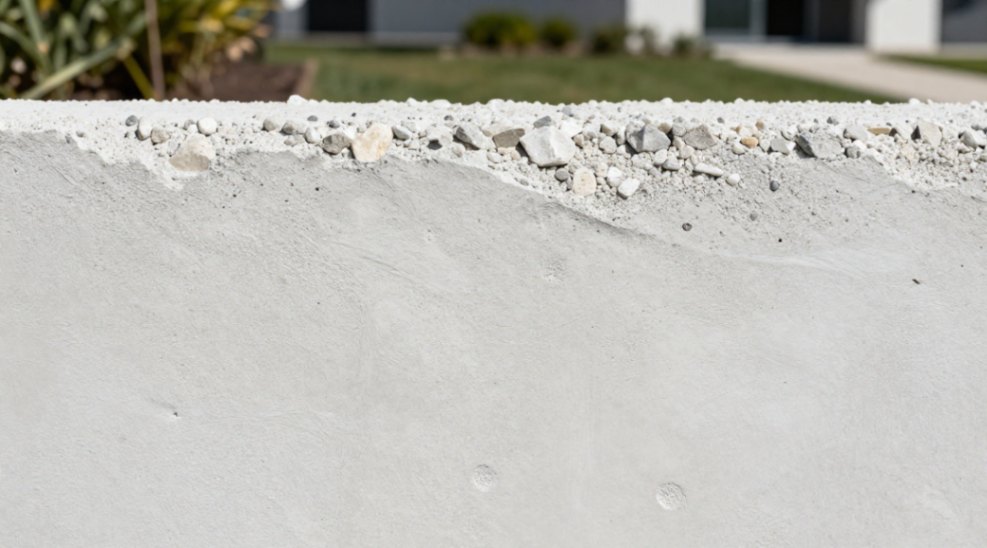
This is the number one killer of white concrete projects. Gray concrete mixes rely on gray Portland cement and dark aggregates. Replacing them with white cement is not enough. You must control every component.
What NOT to Do
- Do not use gray Portland cement. It will dominate the final color.
- Do not use standard river gravel or crushed limestone. These contain iron oxides that cause yellow or brown spots.
- Do not add random pigments. White concrete is about purity, not tinting.
What to Do Instead: The Correct Mix Design
For a structurally sound and visually uniform white concrete staircase, you need the following:
- Cement: Use only white Portland cement (Type I or Type III depending on setting speed). Ensure it is from a single lot to avoid color variation.
- Aggregates: Select pure white or light-colored aggregates. Crushed marble, white quartz, or light-colored granite are ideal. Avoid any aggregate with high iron content.
- Pigments: If you need a slight tint, use only high-quality titanium dioxide-based pigments. For pure white, add 5-10% titanium dioxide by weight of cement.
- Water: Use clean, potable water. Even small amounts of iron or organic material in the water will cause staining.
Data Point: A 2022 study by the International Concrete Repair Institute found that 67% of discoloration complaints on white concrete stairs were traced back to using non-white aggregates.
2. Ignoring the Strength and Durability Requirements for Stairs
White concrete for steps and stairs must bear heavy loads—people, furniture, appliances. It also faces freeze-thaw cycles if outdoors. Aesthetic-only thinking leads to failure.
Critical Engineering Constraints
- Compressive Strength: For residential stairs, target a minimum of 3,000 psi (20.7 MPa). For commercial, high-traffic stairs, do not go below 4,000 psi (27.6 MPa).
- Flexural Strength: Stair treads are thin sections (typically 4-6 inches). They need flexural strength to span between supports. A mix with a water-cement ratio below 0.45 is essential.
- Reinforcement: Never omit steel reinforcement. Use epoxy-coated rebar (green) to prevent rust stains from leaching through the white surface.
What Happens When You Ignore This
I have inspected stairs where the corners crumbled within one year. The owner used a low-strength decorative mix. The cost of demolition and replacement was three times the original budget. Do not make this mistake.
3. Skipping the Non-Slip Finish on Treads
White concrete stairs in modern architecture look stunning with a polished mirror finish. But polished surfaces are dangerously slippery, especially when wet or dusty. The beauty vanishes if someone falls.
Safe Surface Finish Options for White Concrete
- Exposed Aggregate Finish: Use fine white aggregate (1/8 to 3/16 inch). Wash the surface to expose the aggregate after initial set. This creates natural micro-texture.
- Broom Finish: Drag a soft-bristle broom across the fresh concrete surface perpendicular to the direction of travel. Creates a fine-line grip.
- Acid Etch: After curing, apply a mild acid etch (e.g., 10% muriatic acid solution) to remove the smooth surface layer. Rinse thoroughly with water.
- Non-Slip Additives: Mix aluminum oxide or silica sand into the top 1/8 inch of the concrete during finishing. These particles are white or clear and do not affect the color.
Expert Quote: “A white staircase that cannot be safely walked on is not a design success—it is a liability. Install non-slip treads as standard practice.” — John R. Ackerman, FASTM, Structural Concrete Specialist
4. Pouring Without a Plan for Clean Edges and Uniform Color
White concrete reveals every imperfection. A wavy edge or a darker patch on the riser stands out immediately. You must control the formwork and the pour sequence.
Formwork and Pouring Techniques
- Form Material: Use smooth, non-absorbent plywood coated with a white-pigmented form release agent. Brown or oily form oil will stain the white surface.
- Pour Sequence: Pour all risers first, then all treads. Do not pour one step at a time over multiple days. This causes cold joints and color variation.
- Vibration: Use small internal vibrators (1 inch diameter) at 2-foot intervals along each step. Over-vibration or under-vibration creates honeycombing or segregation, ruining the surface.
- Joint Placement: Plan for construction joints at the base of each flight, not in the middle of a tread. A horizontal joint is less visible than a vertical one through the middle of a step.
5. Mishandling Curing to Prevent Cracks and Discoloration
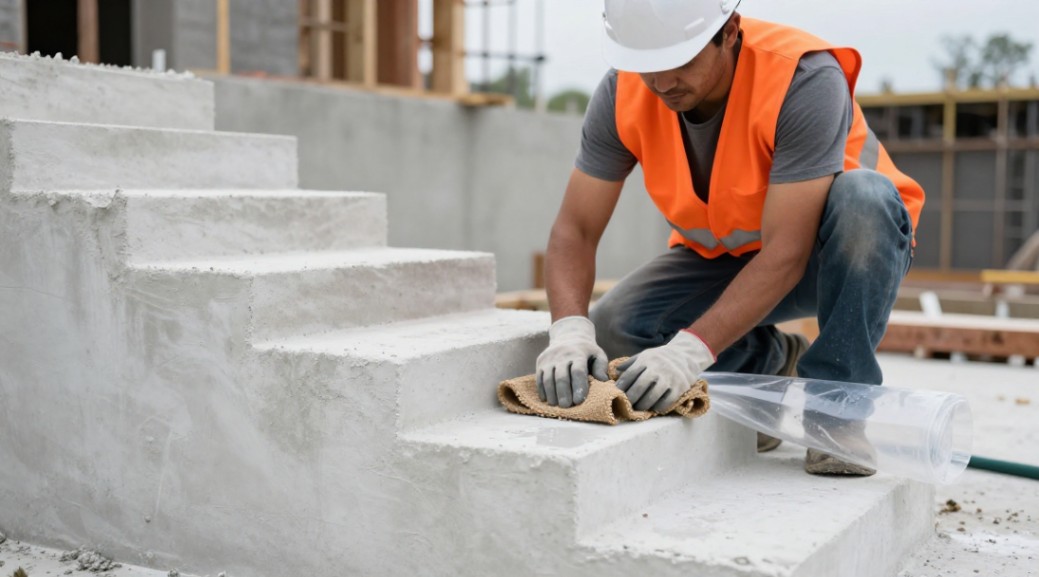
Correct Curing Method for White Stairs
- Wet Curing: Immediately after finishing, cover the concrete with wet burlap and plastic sheeting. Keep the surfaces moist for at least 7 days. Re-wet the burlap daily.
- Curing Compound: If wet curing is impractical, use a white-pigmented curing compound. Apply it evenly over all surfaces immediately after finishing. The white compound helps reflect sunlight and reduces temperature stress.
- What NOT to Do: Do not allow the concrete to dry out in direct sunlight. Do not use clear curing compounds—they do not protect against heat.
Warning: Plastic shrinkage cracks on white concrete look like dark hairline fractures. They trap dirt and become permanent black lines. Follow the curing guidelines strictly.
6. Neglecting Protection Against Staining and Efflorescence
Efflorescence (white powdery salt deposits) is the enemy of true white concrete. It creates a patchy, uneven appearance. Stain from dirt, leaves, and metal is also a constant threat.
How to Preserve the White Surface
- Sealer Application: Apply a high-quality, breathable penetrating sealer designed for white concrete. Sikagard or similar products. Apply two coats after the concrete has cured for 28 days.
- Efflorescence Prevention: Use a low-alkali white cement. Specify a cement with a total alkali content below 0.6%. This reduces the free lime that forms efflorescence.
- Maintenance: Clean white stairs weekly with a pH-neutral cleaner and a soft brush. Do not use acidic cleaners or pressure washers at high PSI—they erode the surface.
Cost Consideration: A good penetrating sealer costs $0.50 to $0.80 per square foot. A single gallon covers about 200 square feet. This is a tiny investment compared to the cost of stain removal or replacement.
7. Choosing the Wrong Supply Method: Ready-Mix vs. Site-Mixed
Your choice between ready-mixed concrete delivered by truck and site-mixed concrete from a small mixer affects color consistency, cost, and logistics. Both have hidden dangers.
When to Use Each
| Factor | Ready-Mix | Site-Mixed |
|---|---|---|
| Color Consistency | High, provided the plant uses the same white cement lot and aggregates for the entire order. | Lower due to batching errors, inconsistent water addition, and cleaning between batches. |
| Minimum Volume | Typically 1 cubic yard minimum. Good for large stairs (3+ steps). | No minimum. Ideal for small residential projects (1-3 steps). |
| Cost | $140-$180 per cubic yard (including delivery). Higher initial cost. | $80-$120 per cubic yard (materials only). Lower material cost, but requires labour for mixing. |
| Risk | Washout water from the truck drum can contaminate the mix if not drained properly. Specify a dedicated washout. | Inconsistent strength if mixing is not precise. Use a volumetric mixer or a mobile batch plant for best results. |
Recommendation: For any project with more than 4 steps, use ready-mix from a plant that specializes in white concrete. Have the plant send a sample of the fresh concrete for color approval before the truck leaves. For one or two steps, site-mixing with a dedicated mortar mixer and bagged white concrete mix (like Sakrete White Concrete Mix) is reliable and cost-effective.
Your Next Step: Protect Your Investment
White concrete for steps and stairs is a stunning choice—when done correctly. You now know the seven critical traps and the precise methods to avoid them. Do not let a beautiful project become a costly lesson.
Before you pour, do this: Write down your mix design, your reinforcement plan, your curing method, and your sealer choice. Share it with a qualified concrete professional. Ask them: ‘What could go wrong with this plan?’ The answer might save you thousands.
If you want a proven, pre-tested solution for small to medium stair projects, consider a bagged white concrete mix. These mixes are laboratory-designed for consistent color and strength. You avoid the risk of batching errors.
Take action today. Your white stairs deserve the right start.
Supplier
We are a supplier under TRUNNANO of Concrete Admixture with over 12 years of experience in nano-building energy conservation and nanotechnology development. It accepts payment via Credit Card, T/T, West Union and Paypal. TRUNNANO will ship the goods to customers overseas through FedEx, DHL, by air, or by sea. If you are looking for concrete admixture, please feel free to contact us and send an inquiry.


