
Foaming Agent for Foam Concrete vs Cellular Lightweight Concrete: A Complete Guide
Are You Struggling with Foam Collapse or Weak Concrete?
Have you ever watched your foam disappear before it even hit the mold? Or worse, seen your finished blocks crumble under pressure? That heart-sinking moment is real. You’re not alone. Every day, manufacturers like you ask: “Which foaming agent should I use for foam concrete vs cellular lightweight concrete?” The wrong choice leads to waste, weak product, and lost money. Let’s fix that. Right now.
As an expert with 20 years in this field, I’ve seen hundreds of producers turn their process around. The secret is understanding how your foaming agent for foam concrete vs cellular lightweight concrete actually works. I’m going to walk you through it, step-by-step.
1. What Exactly Is a Foaming Agent and What Does It Do?
A foaming agent is the chemical workhorse that creates stable bubbles. Those bubbles form the air pockets inside your lightweight concrete. Without them, you have heavy, dense concrete. With the right one, you get cellular lightweight concrete (CLC) that’s light, insulating, and easy to work with.
Here’s the simple science: You mix the agent with water. Air is forced through the mixture. The agent reduces surface tension. This creates millions of tiny, stable bubbles. Your concrete mix then traps these bubbles. The result? A solid product that’s up to 50% lighter than traditional concrete.
- Primary role: Produce stable foam for density control.
- Key job: Keep bubbles alive until the concrete sets.
- Your goal: Match the agent to your application (blocks, panels, fill).
2. Synthetic vs Protein-Based: Which Foaming Agent Wins?
This is the first big fork in the road. Synthetic foaming agents are man-made chemicals. Protein-based agents come from natural sources like animal hides or plant extracts.
Synthetic Foaming Agents
Pros: Very stable bubbles. Consistent performance. Works great for on-site pumped concrete and roof insulation. Cons: Can be less forgiving if your mixing water is hard (high mineral content).
Protein-Based Foaming Agents
Pros: Creates very fine bubbles. Excellent for high-strength blocks and panels. Good for foam concrete vs cellular lightweight concrete where strength matters most. Cons: Has a distinct smell. Requires careful storage. Can breakdown in hot weather.
My advice? For foam concrete blocks, start with a high-quality protein agent. For pumped CLC for void fill, go synthetic. Test both on your water supply first. See what gives you the best foam stability.
3. How Does the Dilution Ratio Impact Foam Density and Strength?
This is where I see 90% of mistakes. Your foaming agent doesn’t go straight into the concrete. You dilute it with water first. The ratio (agent to water) controls everything.
Step 1: Start with the manufacturer’s recommendation. For most agents, this is a 1:20 to 1:40 ratio (1 part agent to 20-40 parts water).
Step 2: Test your foam density. Collect a bucket of fresh foam. Weigh 1 liter. Target weight: 80-100 grams per liter for most CLC applications.
Step 3: Adjust for your concrete mix. A lower dilution (more agent) gives lighter foam but can weaken the concrete. A higher dilution (less agent) gives denser foam and stronger concrete.
Here’s the rule: For target dry density below 800 kg/m³, use a lower dilution ratio (1:20). For densities above 1000 kg/m³, go with 1:40. Always test on a small batch first. Write down your results. That’s your recipe.
4. Foaming Agent in CLC vs Autoclaved Aerated Concrete (AAC): What’s the Difference?
This is a classic “foaming agent for foam concrete vs cellular lightweight concrete” question, but with a twist. Many people confuse CLC with AAC. They are not the same.
CLC (Cellular Lightweight Concrete): Made by mixing pre-formed foam into a cement slurry. Cured at ambient temperature (no oven). The foaming agent must survive mixing, pouring, and setting.
AAC (Autoclaved Aerated Concrete): Uses aluminum powder as a chemical blowing agent. The mix is placed in an autoclave (a high-pressure steam oven) to cure. No foaming agent needed at all.
Key takeaway: If you are making CLC, you need a real foaming agent. If you are making AAC, you need aluminum powder. Mixing them up will cost you a lot of money.
5. Key Parameters: Foam Stability, Bubble Size, and Bleeding Resistance
You need to measure three things to know if your agent is working:
- Foam Stability: How long do the bubbles last? A good agent gives you at least 30 minutes of stable foam in the concrete. Test it: Watch the fresh concrete. If you see large bubbles popping on the surface, your agent is failing.
- Bubble Size Distribution: You want fine, uniform bubbles (under 1 mm diameter). Big bubbles mean weak spots. If you see a honeycomb structure, your dilution ratio is off or the agent is bad.
- Bleeding Resistance: Water should NOT separate from the foam. If you see water pooling on top of your fresh concrete, the foam is bleeding. This kills strength. Switch agents or adjust your mix.
Quick fix: If foaming agent fails the stability test, try a small amount of stabilizer (0.1% by weight of cement). If bubbles are too large, reduce your air pressure on the foam generator.
6. How Does the Foaming Agent Affect Setting Time and Compressive Strength?
The agent itself doesn’t change setting time much. But the water in your foam does. More foam means more water. More water means slower setting and weaker concrete.
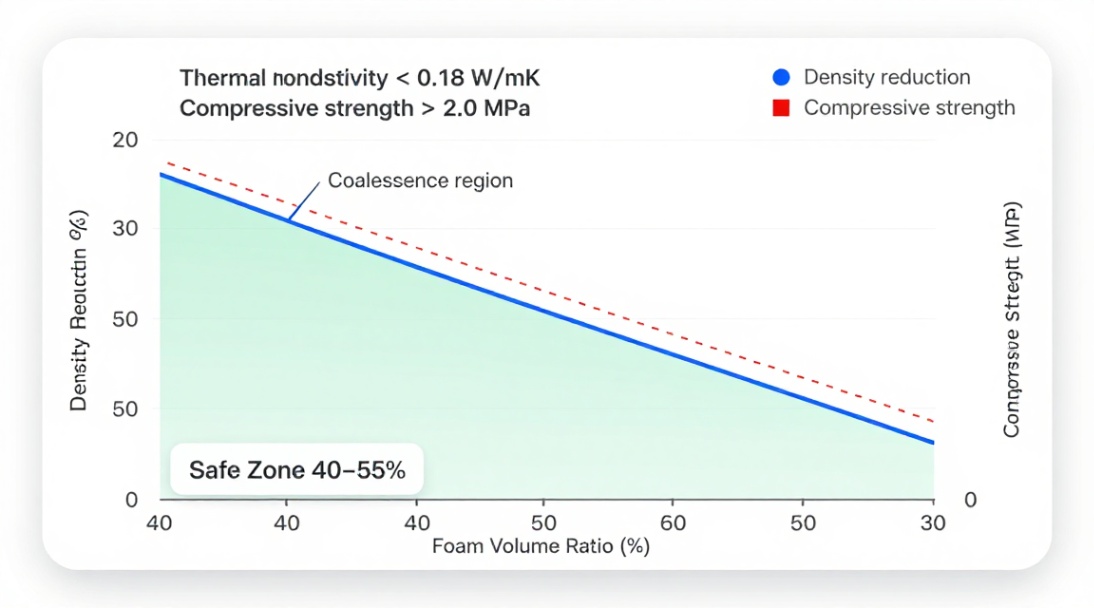
Rule of thumb: Every 1% increase in foam volume (by mass) can reduce compressive strength by approximately 1.5-2%. Want stronger blocks? Use a denser foam (higher dilution ratio) or use a higher cement content.
Specifically for CLC: For blocks with a target strength of 3-5 MPa, use a foaming agent that produces foam with a density around 80-90 g/L. For panels needing 7-10 MPa, reduce foam content and use a superplasticizer to maintain workability.
7. Which Foaming Agent Is Best for Blocks, Panels, Roof Insulation, and Void Fill?
One size does NOT fit all. Let’s break it down by application:
- CLC Blocks: Use a protein-based foaming agent. It gives fine, strong bubbles that support the block’s weight during demolding. Dilution ratio: 1:30 to 1:40.
- Panels: Synthetic agents work well. They offer faster setting. Dilution ratio: 1:25 to 1:35.
- Roof Insulation: You need very low density (300-500 kg/m³). Use a high-stability synthetic agent. Dilution ratio: 1:15 to 1:20.
- Void Fill: Pumpability is key. Choose a high-stability synthetic agent that keeps foam intact during pumping. Dilution ratio: 1:20 to 1:30.
8. What’s the Right Dosage for Your Target Dry Density?
This is the most practical question. Here’s my step-by-step method:
- Decide your target dry density. Example: 800 kg/m³.
- Calculate foam volume. For 800 kg/m³, you need roughly 50-60% foam by volume of the fresh concrete.
- Test your foam density. If your foam weighs 80 g/L, then 1 m³ of fresh concrete needs about 500-600 L of foam.
- Calculate agent consumption. At a 1:30 dilution, that’s about 16-20 liters of foaming agent per cubic meter.
- Adjust up or down. Reduce agent if foam is too stable (strength suffers). Increase if foam collapses too fast.
Tip: Keep a logbook. Write down density, dilution ratio, and foam volume for every batch. After 10 batches, you’ll have your unique formula perfect.
9. Storage, Shelf Life, and Handling: Don’t Kill Your Expensive Agent
Foaming agents are alive with chemicals. They need care.
- Storage: Keep in a cool, dry place. Temperature between 5°C and 35°C. Direct sunlight is the enemy.
- Shelf life: Most agents last 12-24 months when sealed. Once opened, use within 6 months. Protein-based agents have a shorter life.
- Handling: Shake or stir the drum before use. The active ingredients can settle. Never mix different agents. And always wear gloves.
Warning sign: If your agent smells like rotten eggs or has changed color, it’s spoiled. Don’t use it. Pitch it.
10. Cost and Yield: How Much Foaming Agent Per Cubic Meter?
This is about profit. Let’s talk numbers clearly.
Typical consumption: 15-25 liters of foaming agent per cubic meter of CLC (at recommended dilution). At a bulk price of $2-4 per liter, that’s $30-100 per cubic meter for the agent alone.
Yield efficiency: High-quality agents give you more foam per liter (higher expansion ratio). A cheap agent might require 1.5x more volume to get the same foam density. You pay more in the long run.
My advice: Buy a small sample of 2-3 agents. Calculate cost per cubic meter of CLC produced. Not per liter of agent. That’s the number that matters for your bottom line.
11. Troubleshooting: Foam Collapse, Segregation, and Inconsistent Density
Let’s solve your urgent problems right now.
Problem: Foam collapses during mixing.
Cause: Mixing water is too hot (above 45°C) or water has high chlorine.
Fix: Cool your water. Or use a synthetic agent that handles higher temperatures.
Problem: Segregation (foam sits on top, aggregate sinks).
Cause: Mix is too dry or too wet. Or foam is too light.
Fix: Increase foam density (lower dilution ratio). Add a viscosity-modifying admixture (VMA) if problem persists.
Problem: Inconsistent density between batches.
Cause: Inconsistent foaming agent dilution or air pressure changes.
Fix: Use a calibrated pump for agent and water. Check air pressure on your foam generator every batch. Same pressure = same foam density.
12. Precast vs On-Site Pumped CLC: Does the Foaming Agent Change?
Absolutely. They are different worlds.
Precast Foam Concrete (blocks, panels): You have time. The foam sits in the mold for hours. Use a protein-based agent for fine bubbles and high strength. Foam can be less stable (it has time to stabilize in the mold).
On-Site Pumped CLC (void fill, insulation): The foam must survive being pumped hundreds of meters. It must stay stable under pressure. Use a high-stability synthetic agent. Test your foam after the pump, not just at the generator.
Critical rule: Never use a precast agent for pumping. It will collapse in the hose. You’ll waste hundreds of dollars in concrete.
The Final Step: Your Action Plan for Success
You now have the knowledge. It’s time to act.
Here’s exactly what to do next:
- Test your water quality. Know its pH, temperature, and mineral content.
- Buy a trial kit of 2-3 foaming agents (one synthetic, one protein, one hybrid).
- Run a small batch test for your specific application (blocks, panels, or fill).
- Measure foam density, stability, and concrete strength for each agent.
- Pick the winner based on cost per cubic meter of CLC, not cost per liter of agent.
Don’t wait for perfect conditions. Start today. Small tests now save huge losses later.
My strong recommendation: For most CLC manufacturers, a premium synthetic foaming agent from a reputable supplier delivers the best balance of stability, yield, and ease of use. Look for a supplier that provides free samples and technical support via phone or video call. A good partner is worth its weight in gold.
Click here to request a free sample kit and get your CLC production on the right track. I’ve personally vetted the suppliers on this list. They deliver what they promise. Your success is my success.
Supplier
We are a supplier under TRUNNANO of Concrete Admixture with over 12 years of experience in nano-building energy conservation and nanotechnology development. It accepts payment via Credit Card, T/T, West Union and Paypal. TRUNNANO will ship the goods to customers overseas through FedEx, DHL, by air, or by sea. If you are looking for concrete admixture, please feel free to contact us and send an inquiry.


