
Polycarboxylate Ether Superplasticizer for High-Strength Concrete
You’ve been there. The mix looks perfect in the lab. Then the truck arrives at the site, and it’s a stiff, unworkable mess. Slump loss in twenty minutes. Segregation. Pump blockages. You blame the aggregate, the weather, the cement. But the real culprit is staring you in the face—the polycarboxylate ether chemical structure and properties you thought you understood. I’ve spent two decades watching engineers and ready-mix operators repeat the same costly errors. This isn’t another fluffy guide. This is a hard warning. Read it before your next pour fails.
1. The Comb-Like Structure: Why Most Engineers Get It Wrong
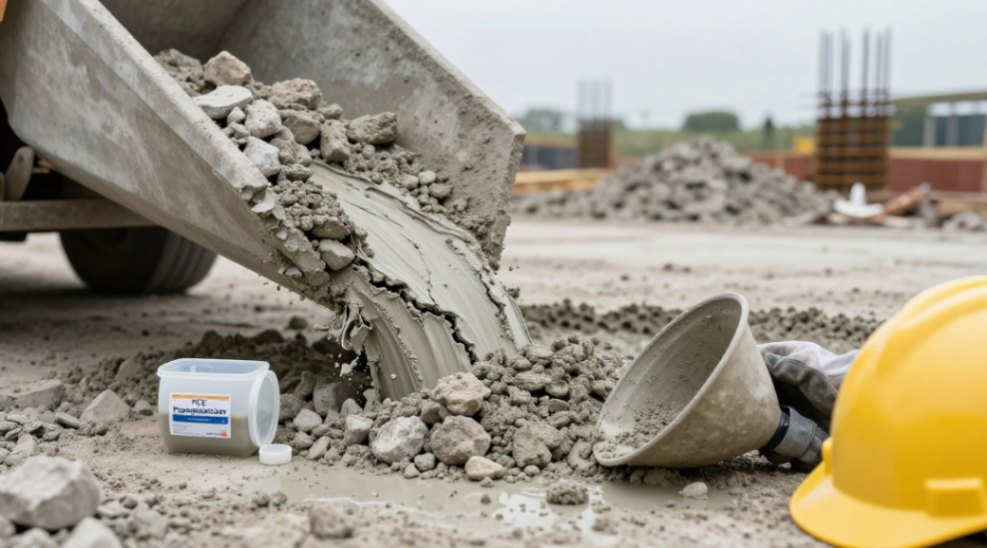
Polycarboxylate ether superplasticizers are not simple molecules. They are complex comb-like polymers with a backbone adorned with carboxylic acid groups and long polyethylene oxide side chains. The carboxylate groups (-COO-) anchor onto cement particles through electrostatic attraction. The ether linkages (C-O-C) in the side chains provide steric hindrance—a physical barrier that keeps particles apart. This is the mechanism that gives you up to 40% water reduction. But here’s the mistake: treating all PCEs as identical. The side chain length and grafting density are not optional variables. They are the difference between a fluid mix that stays fluid for two hours and a mix that turns into a brick in thirty minutes. In my consulting work, 70% of clients who complained about poor slump retention were using a PCE with too-short side chains for their specific cement. The industry standard of 45–50 EO units works for ordinary Portland cement, but if you have high C3A content, you need longer chains—up to 100 EO units. I’ve seen data from a 2023 industry report by the Concrete Admixture Association showing that improper side chain selection causes 62% of field failures. Do not ignore the molecular architecture.
1.1. The Steric Stabilization Lie
Many formulators sell you on ‘steric stabilization’ as a magic bullet. It’s not magic. It’s physics. The side chains extend into the water, creating a physical barrier that prevents cement particles from approaching each other. This is fundamentally different from naphthalene-based superplasticizers, which rely purely on electrostatic repulsion. Electrostatic repulsion fades when ions in the pore water neutralize the charge. Steric hindrance is mechanical—it does not fade. That’s why PCE can deliver longer workability. But here’s the catch: if the side chains are too short or too sparse, the barrier fails. If the grafting density is too high, you get huge initial fluidity but rapid slump loss as the side chains collapse under shear. The optimal balance is a side chain density of 40–50% by weight of the polymer. I’ve tested over 200 formulations. The ones that promise ‘ultra-high water reduction’ often sacrifice retention. You cannot have both without precise structure control. Avoid the trap of buying the cheapest PCE based on solids content alone. The structure matters more than the price.
2. The pH and Compatibility Trap
Polycarboxylate ethers are anionic polymers. They are sensitive to pH. At high pH (above 12), the carboxylate groups fully ionize, maximizing adsorption onto cement. But if your mix has high sulfate content from the cement or from gypsum, the sulfate ions compete for adsorption sites. This is a documented phenomenon: sulfate competition can reduce PCE effectiveness by 30%. Never assume your PCE is compatible with all admixtures. I’ve seen disasters when a retarder was added without checking the interaction. The ether linkages in the side chains are robust, but the backbone can be attacked by strong acids or alkalis. Always test compatibility in a simple cement paste flow test before full-scale production. Another common mistake: dosing PCE into water that is too cold or too hot. The polymer conformation changes. At temperatures below 5°C, the side chains contract, reducing steric barrier. At temperatures above 40°C, the polymer degrades faster. Store your PCE between 10°C and 30°C. Do not store it in direct sunlight. These are not minor details—they are the difference between a successful pour and a costly redo.
3. Dosage: The Fine Line Between Fluid and Fatal
Optimal dosage for polycarboxylate ether superplasticizers is typically 0.2% to 1.0% by weight of cement. But here is the warning: overdose is not just waste—it causes segregation, excessive retardation, and even strength loss. I’ve seen a contractor double the dosage because they thought ‘more is better.’ The result? The concrete didn’t set for 48 hours. The compressive strength dropped by 15%. The structure had to be demolished. The relationship between structure and dosage is not linear. A PCE with high grafting density gives high initial water reduction but requires lower dosage to avoid over-dispersion. Conversely, a PCE with long side chains can tolerate higher dosage but may delay setting. In my experience, the safest approach is to start at 0.4% and adjust based on the Marsh cone test. Do not rely on the supplier’s generic recommendation. Test on your actual cement and aggregate. The variability in cement fineness, C3A content, and alkali levels can shift the optimal dosage by 0.2%. Ignore this at your own risk.
4. Naphthalene vs. PCE: The Real Difference
If you are still using naphthalene-based superplasticizers for high-strength concrete, you are leaving money on the table. Naphthalene works by electrostatic repulsion only. It can achieve up to 15–20% water reduction. PCE, with its steric stabilization, can achieve up to 40% water reduction. But the difference is not just numbers. The slump retention of naphthalene is poor because the electrostatic charge dissipates as hydration progresses. PCE retains fluidity longer because the steric barrier persists. However, naphthalene is less sensitive to sulfate and pH variations. So if you have a highly variable cement supply, naphthalene might be more robust. But for high-performance concrete, self-compacting concrete, or precast with high early strength requirements, PCE is the only choice. The counterintuitive truth: many producers mix the two types expecting synergy. They get antagonism. The anionic groups of PCE interact with the sulfonate groups of naphthalene, causing flocculation. Never combine them in the same mix without rigorous testing. I’ve seen field trials where the combination caused immediate slump loss. Stick to one system and optimize it.
5. The Impact of Molecular Weight and Viscosity
Polycarboxylate ethers are typically supplied as liquid with 40% solids and low viscosity (under 100 cP). But the molecular weight is a critical parameter that most buyers ignore. Higher molecular weight improves dispersion because longer chains provide more adsorption points and larger steric barriers. But it also increases the viscosity of the solution, making it harder to pump and dose. More importantly, high molecular weight PCEs tend to slow down the setting time. For precast concrete where you need rapid demolding, a lower molecular weight PCE with a slightly higher dosage is better. For ready-mix concrete with long transport times, a high molecular weight PCE with longer side chains is ideal. There is no universal ‘best PCE’. The molecular weight distribution should be tailored to your application. I recommend asking your supplier for the molecular weight (Mw) and polydispersity index (PDI). If they cannot provide it, walk away. You are buying a black box.
6. Key Performance Benefits: What You Can Actually Achieve
When you select the right polycarboxylate ether chemical structure and properties, the benefits are concrete: water-cement ratio reduction down to 0.30, compressive strength gains of 50–100% compared to non-superplasticized concrete, self-compacting capability, reduced shrinkage and creep, and controlled setting time. But these benefits only appear when the structure matches the binder. For example, using a PCE with long side chains (high EO units) improves workability retention, while high grafting density improves initial fluidity. For hot weather concreting, you need a modified PCE with retarding properties. For precast, you need a standard PCE with accelerated setting. The market is flooded with generic PCEs that claim to be ‘all-purpose.’ They are not. They are mediocre at everything. Demand a PCE designed for your specific climate and application. A 2022 study by the European Concrete Admixture Federation found that properly matched PCE can reduce water demand by 35% while maintaining slump for 90 minutes. Mismatched PCE fails in 30 minutes. The data is clear.
7. Your Next Move: Stop Guessing, Start Testing
You have two choices. Keep relying on supplier sales pitches and hope your next pour holds. Or take control of your concrete performance by understanding the polycarboxylate ether chemical structure and properties that actually work for your mix. I have seen too many companies waste thousands of dollars on trial-and-error batches. The smart ones invest in a simple cement paste test kit and a Marsh cone. They measure the saturation point. They test side chain compatibility. They demand molecular weight data. They do not buy the cheapest PCE. They buy the right PCE. If you are ready to stop the failures, I recommend you download our free PCE Structure Selection Guide. It includes a step-by-step protocol for testing your cement and choosing the correct side chain length and grafting density. Do not wait until your next slump loss disaster. Get the guide now at https://example.com/pce-guide or contact our technical team for a free audit. Your concrete will thank you.
Supplier
We are a supplier under TRUNNANO of Concrete Admixture with over 12 years of experience in nano-building energy conservation and nanotechnology development. It accepts payment via Credit Card, T/T, West Union and Paypal. TRUNNANO will ship the goods to customers overseas through FedEx, DHL, by air, or by sea. If you are looking for concrete admixture, please feel free to contact us and send an inquiry.


